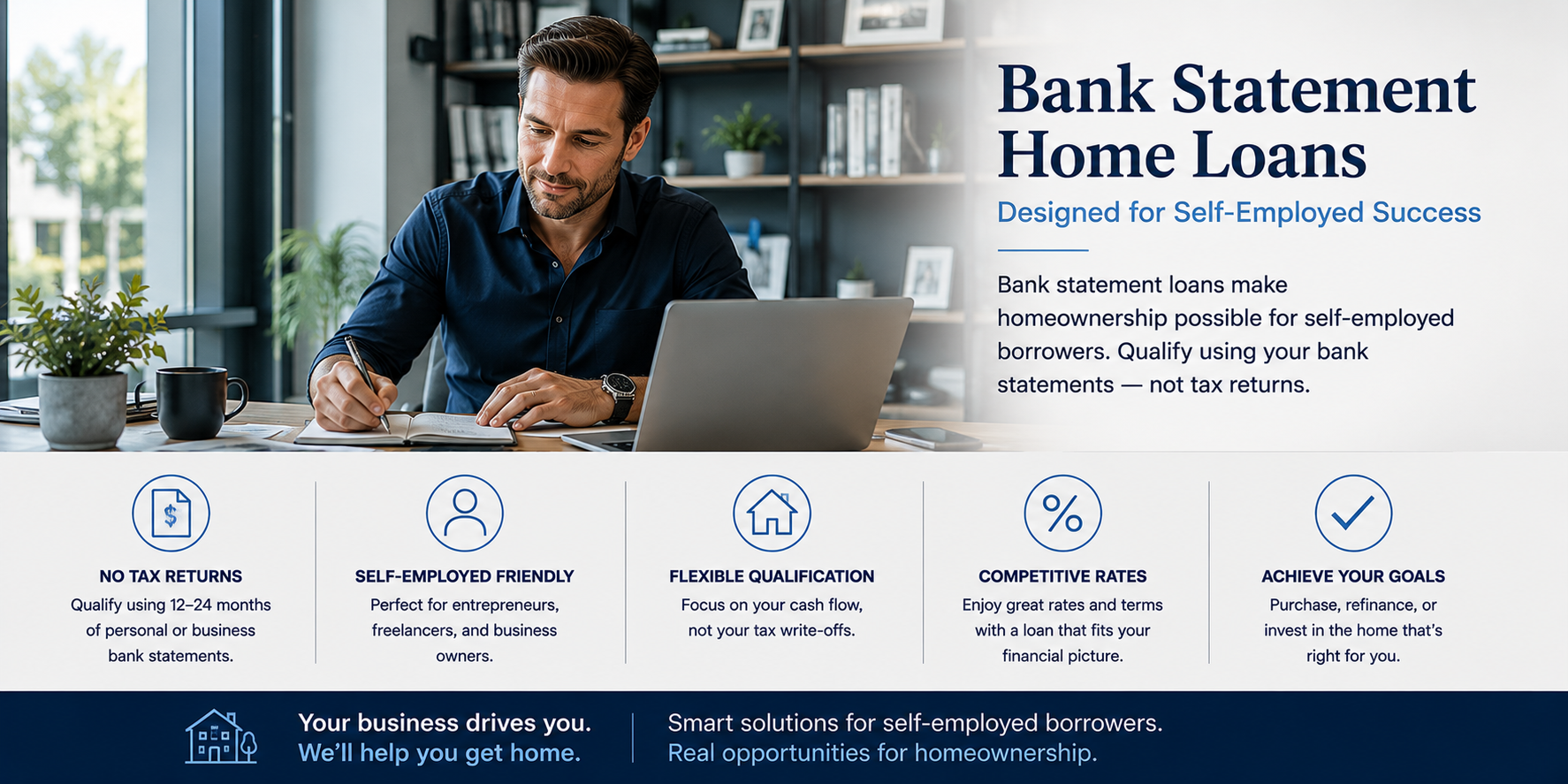
Bank Statement Loans for Self-Employed Borrowers
Bank statement loans are designed for self-employed borrowers, business owners, entrepreneurs, freelancers, and independent contractors who may have difficulty qualifying for a traditional mortgage using tax returns alone.
Instead of relying primarily on W-2s or tax returns, bank statement loan programs allow lenders to evaluate deposits reflected in personal or business bank statements to determine qualifying income.
For many self-employed borrowers, bank statement financing can provide a flexible path to homeownership, refinancing, or real estate investment.
What Is a Bank Statement Loan?
A bank statement loan is a non-QM (Non-Qualified Mortgage) loan program that allows eligible borrowers to qualify using bank deposits rather than traditional income documentation.
These programs are designed for borrowers whose tax returns may not accurately reflect their true cash flow due to business deductions, write-offs, depreciation, or other tax strategies.
Bank statement loans can be used for:
• Primary residences
• Second homes
• Investment properties
• Purchase transactions
• Rate and term refinances
• Cash-out refinances
Who Uses Bank Statement Loans?
Bank statement financing is commonly used by:
• Self-employed business owners
• Realtors
• Mortgage professionals
• Independent contractors
• Consultants
• Sales professionals
• Medical professionals
• Attorneys
• Freelancers
• Gig economy workers
• Commission-based employees
• Entrepreneurs
Many successful borrowers have strong income but struggle to qualify through traditional underwriting because their tax returns show lower taxable income.
How Do Bank Statement Loans Work?
Instead of reviewing traditional tax returns, lenders analyze deposits reflected on bank statements to determine qualifying income.
Depending on the program, lenders may review:
• 12 months of bank statements
• 24 months of bank statements
• Personal bank statements
• Business bank statements
• Profit and loss statements in certain situations
Qualification guidelines vary by lender and loan program.
12-Month vs. 24-Month Bank Statement Programs
Many lenders offer both 12-month and 24-month bank statement options.
12-Month Programs
• Require fewer statements
• May allow faster qualification
• Useful for borrowers with increasing income
24-Month Programs
• Provide a longer income history
• May benefit borrowers with fluctuating income
• Can help demonstrate business stability
The best option depends on your income trends, business structure, and overall financial profile.
Benefits of Bank Statement Loans
Bank statement financing offers several advantages for self-employed borrowers:
• No traditional tax return qualification required in many cases
• Flexible income calculation methods
• Financing for primary, secondary, and investment properties
• Higher loan amounts may be available
• Available for purchases and refinances
• Designed specifically for self-employed borrowers
• Alternative qualification options for complex financial situations
These programs can help borrowers qualify when conventional financing may not be the best fit.
Bank Statement Loans vs Conventional Loans
Conventional mortgage programs typically require:
• Tax returns
• W-2 forms
• Pay stubs
• Employment verification
• Traditional income calculations
Bank statement loans focus on cash flow and deposits rather than taxable income.
This can create opportunities for borrowers whose actual income is significantly higher than what appears on their tax returns.
Frequently Asked Questions
Do I need tax returns for a bank statement loan?
Many bank statement loan programs do not require tax returns for qualification. Requirements vary by lender and program.
Can I qualify using business bank statements?
Yes. Many programs allow qualification using business bank statements, subject to lender guidelines.
Can self-employed borrowers purchase a home using a bank statement loan?
Yes. Bank statement loans are commonly used for home purchases, refinances, and investment property financing.
Are bank statement loans available for investment properties?
Many programs allow financing for investment properties in addition to primary residences and second homes.
Can I refinance using a bank statement loan?
Yes. Bank statement loans may be used for both rate-and-term refinances and cash-out refinances.
Work With Frank Roccuzzo
Frank Roccuzzo, Mortgage Broker with Barrett Financial Group, helps homebuyers, homeowners, self-employed borrowers, and real estate investors explore conventional, FHA, VA, USDA, jumbo, bank statement, DSCR, and other specialized mortgage solutions.
Mortgage financing is available in:
• Arizona
• Florida
• California
• Nevada
• Oregon
• Tennessee
• Pennsylvania
• New Jersey
• Texas
NMLS #1286425
Related Loan Programs
Explore other mortgage options that may fit your home financing goals.